


- Archeologia
- Bibliologia i informatologia
- Bibliotekoznawstwo
- Biologia
- Chemia
- Ekonomia i zarządzanie
- Etnologia i antropologia kulturowa
- Filologia polska
- Filologie obce
- Filozofia
- Fizyka
- Geografia
- Historia
- Informatyka
- Językoznawstwo
- Judaica
- Kultura i sztuka
- Kulturoznawstwo
- Matematyka
- Pedagogika
- Podręczniki dla cudzoziemców
- Politologia i stosunki międzynarodowe
- Prawo
- Promocje
- Psychologia
- Socjologia
- Varia
- 100 Lat Niepodległości
- Akademia Samorządowa
- Akademia Zarządzania i Finansów
- Aktywni (nie)pełnosprawni
- Analecta Literackie i Językowe
- Bibliotheca Litteraria
- Bibliotheca Philosophica
- Biografia i Badanie Biografii
- Byzantina Lodziensia
- Filmo!znawcy
- Gerontologia
- Interdyscyplinarne Studia Miejskie
- Interpretacje Literackie
- Jerzy Giedroyc i Świadkowie Historii
- Judaica Łódzkie
- Jurysprudencja
- Literaturoznawstwo. Sylwetki
- Manufactura Hispánica Lodziense
- Nauka Sztuki – Sztuka Nauki
- Oblicza feminizmu
- Oblicza Wojny
- Perspektywy Biograficzne
- Polska Kultura Filmowa
- Research on Science & Natural Philosophy
- Series Ceranea
- Skuteczne Zdziwienie
- Sztuka-Media-Kultura
- Twórczość i Edukacja
- Łódzkie Studia z Językoznawstwa Angielskiego i Ogólnego
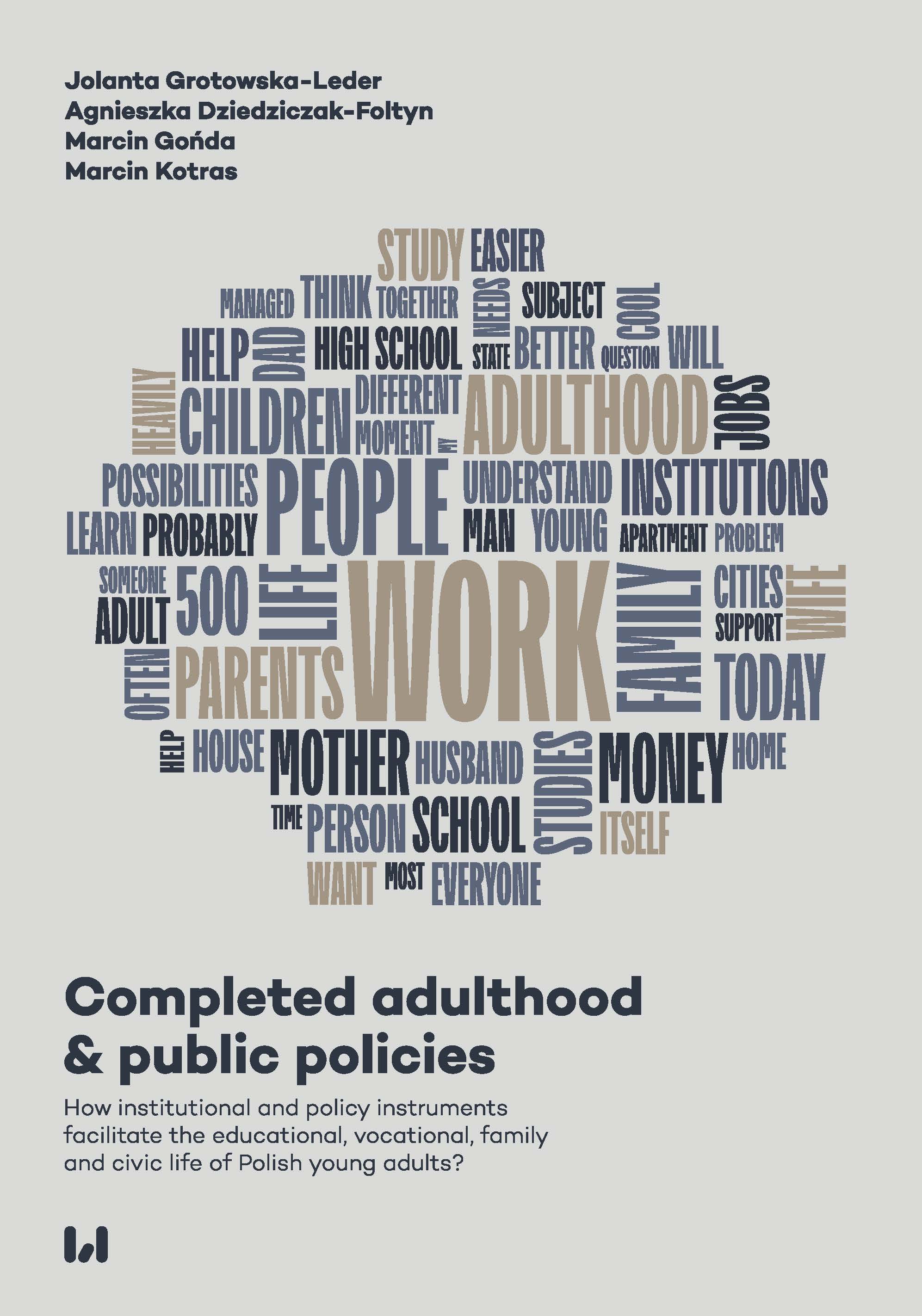
Completed adulthood & public policies
How institutional and policy instruments facilitate the educational. vocational. family and civic life of Polish young adults?
Autor: Jolanta Grotowska-Leder · Agnieszka Dziedziczak-Foltyn · Marcin Gońda · Marcin Kotras
Liczba stron: 262
Rok wydania: 2022
ISBN: 978-83-8220-986-0
e-ISBN: 978-83-8220-987-7
- Opis produktu
- Spis treści
- Recenzje produktu (0)
*
This is a pioneering book on the process of transition to stabilised/completed adulthood, socioeconomic and family conditions and effects in a Poland undergoing profound economic, political and socio-cultural changes.
From the review by prof. Wielisława Warzywoda-Kruszyńska
The reviewed work emanates originality and a non-standard approach both to the theory, the research itself and the presentation of results. Reading this monograph […] leads to the conclusion thot there is no similar work in Poland, and one may risk a thesis that there is no similar work in the EU, and it is good that it will be published in English, inspiring researchers and analysts to […] reflect on life at different stages of development within the human life cycle.
From the review by prof. Krzysztof Czekaj
PART I. CONCEPTUAL AND METHODOLOGICAL FRAMEWORK 17
Chapter 1. Transition into adulthood – theoretical frameworks 19
1.1. Understanding the complete transition into adulthood 19
1.1.1. Adulthood as a stage of psycho-social development 19
1.1.2. Adulthood as a social phenomenon/institution 20
1.1.3. Adulthood as a socio-cultural construct 21
1.1.4. Models of understanding adulthood 21
1.2. Criteria and markers of adulthood 22
1.2.1. Objective criteria for adulthood 22
1.2.2. Subjective criteria for adulthood 24
1.3. Theoretical approaches to the transition into adulthood 25
1.3.1. Life course and life course regime 25
1.3.2. Concepts of entering adulthood 28
1.3.3. Patterns of entering adulthood 30
Chapter 2. Research methods and procedures 37
PART II. THE TRANSITION INTO ADULTHOOD IN THE EXPERIENCES OF POLES 43
Chapter 3. Context and determinants of the process of entering adulthood in Poland 45
3.1. Cultural context 47
3.2. Structural context 49
3.3. Political context 51
Chapter 4. Schooling and adult education 53
4.1. The education situation of young adult Poles in public statistics 54
4.2. Selected theoretical reflections and results of empirical studies of educational careers 58
4.2.1. General education 60
4.2.2. Secondary education 62
4.2.3. Higher education 64
4.2.4. Adult education 65
4.3. Young adults’ educational paths 66
4.3.1. Paths of stopping at the level of primary education 67
4.3.2. Paths of achieving secondary education 69
4.3.3. Higher education paths 71
Chapter 5. Finding work and building a career 75
5.1. The labour market of young Poles in public statistics 76
5.1.1. Economically active young adults 77
5.1.2. Young adult temporary and part-time employees 78
5.1.3. The unemployed and inactive young adults 80
5.2. Selected theoretical and empirical analyses of professional careers 82
5.2.1. Categories describing the course of professional life 83
5.2.2. Types of career paths 84
5.3. Young adult career paths 87
5.3.1. Job plans 87
5.3.2. Ways to look for a job 89
5.3.3. Timing and linearity of entering the labour market 90
5.3.4. First professional experience 90
5.4. Young adults’ professional pathways – between traditional and postmodern pathways 93
5.4.1. The relative stability career 94
5.4.2. The permanent mobility career 96
5.5. Profesional career of young women – between professional and family roles 102
5.6. Job satisfaction 107
Chapter 6. Household and family formation 111
6.1. Household formation 111
6.1.1. Household formation as a stage in achieving completed adulthood 111
6.1.2. The housing situation of young adult Poles in public statistics 112
6.1.3. Paths to getting one’s own housing 115
6.1.4. Prolonged stay in a family home (nesters) 119
6.1.5. Perception of the state’s support 123
6.2. Family formation 124
6.2.1. The family situation of young adult Poles in public statistics 125
6.2.2. Forms of family life 130
6.2.3. Parenthood in achieving adulthood and stabilising family life 135
6.2.4. Split families and single parenthood 138
6.2.5. Perception of the state’s support 139
Chapter 7. Young adults in the public and political sphere 143
7.1. Young adults’ issues in political parties’ programmes and manifestos 144
7.2. How young adults are presented in political discourse 149
7.3. The political participation of young adults 158
7.4. Conventional political participation 160
7.5. Reasons for the low level of political participation 162
7.6. Young adults’ attitudes towards politics and policy 166
Chapter 8. Paths to reaching adulthood 173
8.1. Young adult markers of adulthood 173
8.2. Young adults’ concepts of entering adulthood 174
8.3. Young adults’ pathways into adulthood 176
8.4. Foster care leavers’ pathways into adulthood 182
8.4.1. Pathways of transitioning from education to the labour market 184
8.4.2. Pathways to establishing one’s own household and starting a family 186
PART III. PUBLIC POLICIES FOR COMPLETED ADULTHOOD IN POLAND. CONCLUSIONS AND DISCUSSIONS 189
Chapter 9. Public policies for completed adulthood in Poland. Conclusions and Discussions 191
9.1. Public policy and the life course approach 191
9.2. The post-transformation models of Polish social policy 193
9.3. Mapping public policies for young adults 196
9.3.1. Educational regulations 197
9.3.2. Labour market regulations 198
9.3.3. Housing regulations 199
9.3.4. Family regulations 200
9.3.5. Other public policy instruments 201
9.4. Interviewees’ evaluation of social policy 210
Conclusions. Proposals concerning social policy 213
References 215
List of tables 239
Appendices 241
Appendix 1. List of interviewees (IDI) 241
Appendix 2. List of interviews (FGI) 250
Appendix 3. In-depth interview (IDI) scenario 252
Appendix 4. Focus group interview (FGI) scenarios 256
Nikt jeszcze nie napisał recenzji do tego produktu. Bądź pierwszy i napisz recenzję.
Tylko zarejestrowani klienci mogą pisać recenzje do produktów. Jeżeli posiadasz konto w naszym sklepie zaloguj się na nie, jeżeli nie załóż bezpłatne konto i napisz recenzję.
